© 2035 by The Clinic. Powered and secured by Wix

Dyeing
Only linen and silk fabrics, hand-dyed with soil and lava from various regions of Japan. Wrapped in the essence of the earth, bringing calm to mind and body.

Linen stole

Hemp is humanity’s oldest fiber, a plant used around the world since ancient times. In Japan, it is known to have been used as far back as the Jōmon period. The word “Jōmon” literally means “rope pattern,” and the ropes it refers to were made from hemp.
Hemp is also mentioned in many historical Japanese texts as a sacred treasure of the gods. It was used in rituals and ceremonies, regarded as a holy plant capable of purifying sins and impurities.
Wearing hemp brings a unique sense of protection, allowing one to feel at ease and fully oneself—perhaps this is why.
Wild Silk stole

The history of wild silk, or silk from wild silkworms, dates back to ancient times, long before the domesticated silkworm was born.
Because it is harvested from wild species, wild silk cannot be mass-produced like domesticated silk, making it rare and highly valued.
Since ancient times, it has been used for special garments worn by royalty and the aristocracy.
Wild silk predates sericulture and represents the very origins of humanity’s relationship with fibers, coexisting with nature’s silkworms.
Unlike domesticated silkworms, wild silkworms grow freely in forests, spinning their own cocoons.
In regions such as northern India and Southeast Asia, the silk is harvested following natural cycles. Its unique texture and durability have made it highly prized, and it continues to be used today as a luxurious natural fiber.
Wearing wild silk allows one to feel the powerful energy of living creatures and to reconnect with the deep bond between humans and nature.
Clothing

Clothing by Ametsuchi is designed with timeless silhouettes meant to be worn for many years. Fabrics dyed with earth gradually fade as time passes.
With a deep respect for the gifts of the earth, fabrics are cut to make the most of every piece, minimizing waste. Any remaining fabric is transformed into new products, given a second life.
We hope you will enjoy these changes in color and continue wearing the garments for a long time, embracing the natural flow of time.
Ametsuchi garments are also made by hand. Each piece is carefully sewn and hand-dyed, one by one. No two are ever the same. We would be honored if you choose to wear a piece that is uniquely yours.

Washi


Washi is a paper with a long and important history, deeply connected to the development of Japanese life and culture. Since papermaking techniques were introduced during the Asuka period, washi has formed the foundation for record-keeping, spirituality, and artistic expression.
From early times, it supported the formation of the Japanese state and spiritual culture, playing an essential role in poetry, calligraphy, and illustrated scrolls.
Through these cultural arts, washi has conveyed the Japanese sense of beauty and sensitivity. Widely used in everyday tools as well, washi is deeply rooted in daily life. Because of this long history and cultural value, washi is not merely paper, but a material that carries the history and spirit of Japan, carefully preserved and passed down to this day.
Ametsuchi uses Tokuji Washi (Yamaguchi Prefecture) and Inshu Washi (Tottori Prefecture) for its washi products. Each sheet is hand-made by skilled artisans, then treated with persimmon tannin and konnyaku starch, resulting in washi that is strong, durable, and water-resistant.
Tokuji Washi is a traditional hand-made paper from Tokuji, Yamaguchi City, with origins dating back to the Kamakura period. Recognized as an intangible cultural asset, it is made using abundant natural materials—such as kozo and mitsumata—and pure water. It is known for its rustic texture, strength, and soft feel.
Inshu Washi is hand-made in Tottori Prefecture, with a history of approximately 1,300 years. Crafted from natural fibers such as kozo, mitsumata, and gampi, it preserves traditional techniques and is designated as a national traditional craft of Japan.
Card Holder
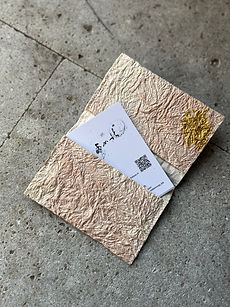
A business card holder made from Inshu Washi, layered with earth tones and gold.
The lining is also crafted from washi. Comes with nurikō incense, gently scenting your business cards with a calming fragrance.
Laptop Case

A laptop case made from earth-dyed Inshu Washi. The lining is crafted from durable washi treated with persimmon tannin.
Panel

A panel made from Inshu Washi, layered with earth and lava pigments.
When displayed on a wall, it creates an atmosphere that envelops the room with the energy of the earth.
Earrings

Accessories made from leftover washi, produced when cutting other products.
This is part of our commitment to using every sheet of hand-made washi to its fullest.
Each piece comes with original Ametsuchi nurikō incense, offering a gentle fragrance throughout the day for a pleasant, calming experience.